


Blade vs Mallet Putters: How to Choose the Right One for Your Stroke
The blade vs mallet putters debate is one of the oldest in golf, and it matters more than most players realize. Putting makes up a big share of your strokes on any given round, yet the putter is often the club people pick on looks alone. The two head shapes actually roll the ball quite differently, and the right one for you comes down to how your stroke moves. In this guide, we will cover what each style does, who tends to benefit from one over the other, and a quick test you can do at home to find your match.
Key Points
- A blade putter has a slim, compact head with most of its weight sitting right behind the face. Blades tend to suit players with a moderate to strong arc in their stroke.
- A mallet putter has a larger head with weight pushed to the perimeter and rear. That raises MOI (moment of inertia), which adds stability and forgiveness on off-center hits.
- Head shape is only part of the story. The neck and balance, meaning toe hang versus face-balanced, matter just as much, and both shapes can be built either way.
- The fastest way to find a good starting point is to identify your stroke type and check the putter’s balance on one finger, but this should be treated as a quick screening test rather than a substitute for a proper fitting. We walk through both below.

What Is a Blade Putter?
A blade putter is the classic, compact shape most golfers picture when they think of a “normal” putter. It is slim from front to back, with most of its mass sitting directly behind the face. The design that set the template is the Ping Anser, introduced back in 1966, and its silhouette is still the most copied putter shape in the game.
Many blades are built with toe hang. If you balance the shaft on one finger, the toe tilts toward the ground, and that weighting nudges the face to open slightly on the way back and close through impact. That behavior suits a stroke that swings on a gentle arc rather than a dead-straight line.
The trade-off is forgiveness. A blade carries less perimeter weighting, so its MOI is lower and the head twists more on off-center hits. In return, a clean strike rewards you with crisp, informative feedback and excellent pace control. Blades tend to fit players who like a simple look at address and enjoy feeling the stroke and shaping it a little.
What Is a Mallet Putter?
A mallet putter has a larger head, with weight moved out to the perimeter and back. That layout raises the moment of inertia, so the head resists twisting when your contact drifts off center. The practical payoff is stability, and it shows up most on longer putts and slight mishits, where a blade would lose more speed and start line.
Mallets also make room for bold alignment aids, like multiple sight lines, high-contrast shapes, and dots that make lining up the ball easier. Many feel a touch softer through impact, especially the ones with a face insert. Because the face tends to stay square to the target line a little longer, mallets often pair well with a straight-back, straight-through stroke or a slight arc, and they are a friendly starting point for newer golfers still grooving a repeatable motion.
One myth worth clearing up: a mallet is not a “beginner-only” club. Plenty of low-handicap and tour players game them. In a 2024 Golf Digest Hot List analysis, 21 of the top 30 players in the world used mallets, a sharp swing from 20 years earlier when most of the top 20 favored blades. Modern mallets also come in a range of sizes, including mid-mallets that split the difference between the two shapes, so the category is far broader than the oversized heads people sometimes picture.
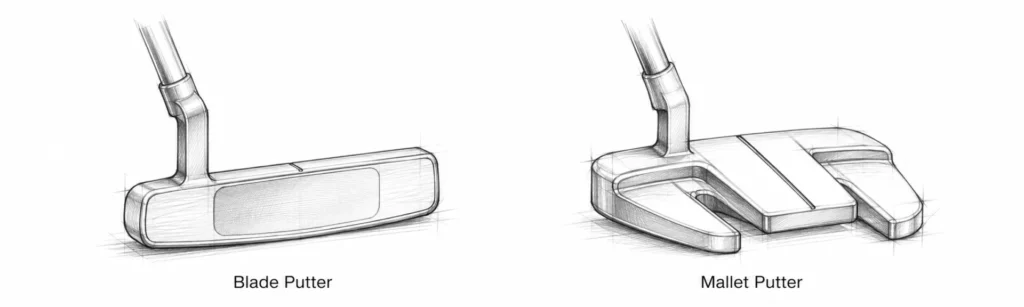
Blade vs Mallet Putters: The Key Differences
Both blade and mallet putters can roll the ball beautifully. The right choice comes down to your stroke pattern, what you like to see at address, and the feedback that helps you control speed and start line. Here is a quick side-by-side of where they differ most.
| Feature | Blade Putter | Mallet Putter |
|---|---|---|
| Head shape | Slim and compact | Larger, with more variety in shapes and sizes |
| Weight distribution | Mass behind the face, often with toe hang | Perimeter and rear, often with adjustable weights |
| Forgiveness (MOI) | Lower, rewards center contact | Higher, steadier on off-center hits |
| Feel and feedback | Crisp and firm, very informative | Smoother, often softer with an insert |
| Alignment aids | Minimal, clean topline | Prominent lines and shapes for aiming |
| Best-fit stroke | Moderate to strong arc | Straight or slight arc (toe-hang options exist for arcs) |
Here is the part that trips up a lot of shoppers: shape alone does not settle the question. You can find a mallet built with toe hang and a blade built close to face-balanced. That means a golfer with an arc can absolutely play a mallet, and a straight-stroke player can find a blade that works. After head shape, the balance of the putter (toe hang versus face-balanced) is arguably the most important spec to get right, which is exactly why the finger test below matters so much.

The Finger Test: How to Tell Which Putter Fits Your Stroke
A good fit starts with understanding your natural stroke, then matching a putter to it. You can get most of the way there at home in a few minutes, using the same balance checks that club fitters and major golf publications rely on.
How to Match a Putter to Your Stroke
- Read your stroke shape. Set your phone down the target line and film a few putts, or have a friend watch. If the head tracks nearly straight with little face rotation, you have a straight or slight-arc stroke. If it swings inside the line and the face opens then closes, you have a moderate to strong arc.
- Balance the putter on one finger. Rest the shaft across a fingertip and let the head hang. If the face points up at the sky, the putter is face-balanced, which suits a straighter stroke. If the toe droops toward the ground, it has toe hang, which suits an arc.
- Match toe hang to the size of your arc. A slight arc pairs with mild toe hang, while a stronger arc wants more. The goal is for the putter’s built-in tendency to work with your stroke, not against it.
- Cross-check with your misses. As a rough guide, players who tend to miss to the right may benefit in some cases from more toe hang, while players who tend to miss to the left may benefit in some cases from a more face-balanced setup.
- Roll real putts with both. Bring your current putter, hit a mix of short and long putts with a blade and a mallet, and watch two things: how tightly your speed and start line group up, and how easily you aim. Those two clues usually make the choice obvious.
If you would rather not guess, a proper fitting removes the doubt. A short session on a putting green, ideally with a launch monitor, will show you your true stroke and let you compare shapes with your own eyes.
So, Which Putter Should You Use?
Neither shape is universally better. The best putter is simply the one that helps you start the ball on your intended line with reliable speed, round after round. That said, a few tendencies hold up well as a starting point.
If you want maximum forgiveness and alignment help, or you are still building a repeatable stroke, start with mallets. If you prefer precise feedback, a clean look at address, and you naturally arc the stroke, try blades. When you are torn between two putters that both feel decent, let confidence break the tie. The one you aim more easily and feel calmer standing over will usually score better, because a settled setup tends to produce a smoother stroke.
Whatever you land on, it helps to buy with a safety net. You can browse the putter selection at Rock Bottom Golf, and the 90 Day Performance Guarantee lets you return a qualifying club for store credit if it does not suit your game.
Blade and Mallet Putter FAQs
Are mallet putters better for beginners?
Often, yes. A mallet’s higher MOI adds forgiveness on off-center hits, and its bold alignment aids make aiming easier, both of which help while you are still building a consistent stroke. That said, it is a starting tendency, not a rule. The better question is what your stroke actually does.
Do all blade putters have toe hang?
Most do, but not all. Toe hang comes from how the shaft and neck attach to the head, so a blade with a different neck can sit closer to face-balanced. Always balance the specific putter on your finger rather than assuming based on the shape.
Can I use a mallet putter if I have an arc stroke?
Yes. Plenty of mallets are built with toe hang, including many mid-mallets and models with a flow or slant neck. That combination gives you a mallet’s stability and alignment help while still working with an arc.
Which putter is more forgiving, a blade or a mallet?
Mallets are generally more forgiving because their perimeter weighting raises MOI and keeps the head from twisting as much on mishits. Blades are less forgiving but reward a center strike with sharper feel and feedback.
How do I know if my putter is face-balanced or toe-hang?
Rest the shaft on one finger and let the head hang. If the face points up at the sky, it is face-balanced and better suited to a straight stroke. If the toe drops toward the ground, it has toe hang and better suits an arc.
Do tour pros use blades or mallets?
Both. You will see plenty of each on tour, and the split comes down to individual stroke type and preference rather than one shape being flatly superior. Copying a pro’s putter without matching their stroke is a common and costly mistake.
Keep Reading

The Short Version
Blades are compact and feedback-rich, and they reward a repeating arc with feel and control. Mallets are larger, more forgiving, and easier to aim, which helps straighter strokes and players still finding their consistency. But do not stop at the silhouette. Read your stroke, balance the putter on one finger, and match the toe hang to your arc. Do that, and you will pick a putter that starts the ball on your line with the speed you want, round after round. When you are ready, browse the full putter lineup at Rock Bottom Golf and find the one that fits your eye.
Writer/Editor: Danny Kapp is a passionate golf enthusiast and a 10-year veteran golf blog writer for Rock Bottom Golf, offering his unique perspective on the game. With a keen eye for detail, he covers various aspects of golf, ranging from technical insights to the latest trends in golf equipment and golf technology.

Sources
- Golf Digest: Are Mallet Putters Better Than Blades? What Our Hot List Player Ratings Reveal (Mike Stachura, July 2024)
- Golf Digest: Could a Toe-Hang Mallet Solve Your Putting Woes?
Last Updated on by Danny Kapp