

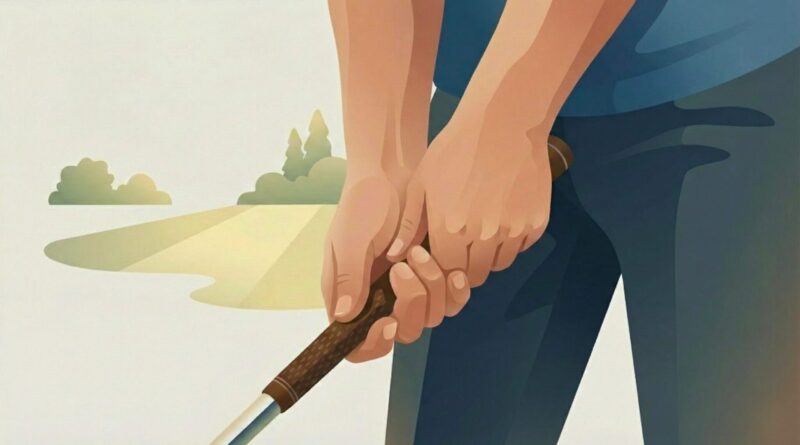
Hooking or Slicing? Learning How to Choose the Right Golf Grip Size Might Fix It
We spend hours researching driver heads and hundreds of dollars upgrading our shafts to match our swing speed. Yet, most amateur golfers completely ignore the only physical connection they actually have with the golf club: the grip. If you don’t know how to choose the right golf grip size, you are overlooking the simplest, most cost-effective way to improve your consistency.
If you are playing standard-sized grips simply because that’s what came stock on your irons, you could be leaving strokes on the course.

Playing the wrong size grip creates unnecessary tension in the hands and forearms, leading to inconsistent face control at impact. The good news? You don’t need a high-tech launch monitor to figure this out. You can diagnose your grip fit at home in less than a minute.
The “Why”: Wrong Golf Grip Size Symptoms
Before we get to sizing, it is important to understand why grip diameter matters. The size of the grip directly influences how “active” your wrists/hands are during the swing.
If your grip size is wrong, your body subconsciously fights the club.


Symptom 1: The Grip is Too Small (The Hook)
If a grip is too thin for your hands, your fingers have to squeeze tighter just to maintain control of the club during the swing. This excess tension engages the small muscles in your forearms too early.
- The Result: Your hands become too “active” or wristy through the impact zone, shutting the clubface down quickly. This can contribute to hooks and pulls, especially for players who already release the club aggressively.
Symptom 2: The Grip is Too Large (The Slice)
Conversely, if a grip feels like you are holding a baseball bat, it inhibits your wrists from hinging and releasing naturally.
- The Result: Your hands become “lazy” or passive. You may find it harder to square the face at impact, which can contribute to slices, blocks, or weak pushes to the right.
The Test: How to Determine Your Grip Size at Home
You don’t need a professional fitting session to find your baseline. The most reliable method for learning how to choose the right golf grip size is the “Finger-to-Palm” test.
Do this right now with one of your current clubs:
- Take your normal golf stance.
- Grip the club with only your top hand (your gloved hand).
- Look closely at the middle two fingers of that hand (the middle and ring finger). Focus on where the fingertips curl around and touch the pad of your thumb/palm.
The Results:
- The Perfect Fit: The tips of your middle two fingers should barely be touching the pad of your thumb. It should feel secure but relaxed.
- Too Small: If your fingernails are digging significantly into your palm pad, the grip is too small. You are likely over-squeezing the club.
- Too Big: If there is a visible gap between your fingertips and your thumb pad—meaning your fingers cannot wrap all the way around to touch your palm—the grip is too large.
The Golf Grip Size Chart (Using Glove Size)
While the finger test is the most accurate measure for your specific hands, your glove size is an excellent starting point for determining where you fall on the spectrum.
Use this chart as a general baseline when shopping for new grips:
| Your Glove Size | Recommended Grip Size |
|---|---|
| Women’s S / M | Ladies Standard (Undersize) |
| Men’s Small / Cadet Small | Men’s Undersize |
| Men’s Medium / ML | Standard |
| Men’s Large / Cadet XL | Midsize (+1/16″) |
| Men’s XL / XXL | Jumbo / Oversize (+1/8″) |
Pro Tip on Sizing: The “Tweener”
If you feel like a Standard grip is too small, but a Midsize feels too bulky, you can fine-tune the fit with tape. Ask your club technician for “Standard plus two wraps.” This adds extra layers of masking tape under the grip to build it up slightly without jumping a full size category.
Even the perfect size grip will hurt your game if it becomes slick. Sweat, sunscreen, and dirt build up over time, causing you to squeeze tighter to maintain control.
Refresh your grips once a month with this simple method:
- Step 1: Mix warm water and mild dish soap in a bucket.
- Step 2: Scrub the grips gently with a soft-bristle brush (or a rough towel).
- Step 3: Rinse with clean water to remove all soap residue.
- Step 4: Pat dry with a towel. You will be amazed at how much “tackiness” returns!
Don’t Forget Texture and Conditions
Once you know how to choose the right golf grip size, the final step is selecting the right material for your game.
- Sweaty Hands or Humid Climates: Look for “Cord” or Hybrid grips. These have fabric threads woven into the rubber to wick away moisture and provide maximum traction.
- Arthritis or Joint Pain: Look for softer materials, often labeled as “Wrap” or specialized arthritic grips. These are usually larger (Midsize or Jumbo) and made of softer compounds to dampen vibration at impact.
- Feel Players: If you play in dry conditions and prioritize “feel,” standard rubber or synthetic grips usually offer the best feedback.

Sizing Up Your Success
Don’t let a $10 piece of rubber ruin your round. Equipment fitting isn’t just for touring pros; it’s for anyone who wants to eliminate variables in their game.
Now that you understand how to choose the right golf grip size, take a hard look at your current set. If your fingernails are digging into your palms and you’re fighting a hook, an upgrade to Midsize grips might be a simple equipment change that helps your consistency.
Writer/Editor: Danny Kapp is a passionate golf enthusiast and a 10-year veteran golf blog writer for Rock Bottom Golf, offering his unique perspective on the game. With a keen eye for detail, he covers various aspects of golf, ranging from technical insights to the latest trends in golf equipment and golf technology.